
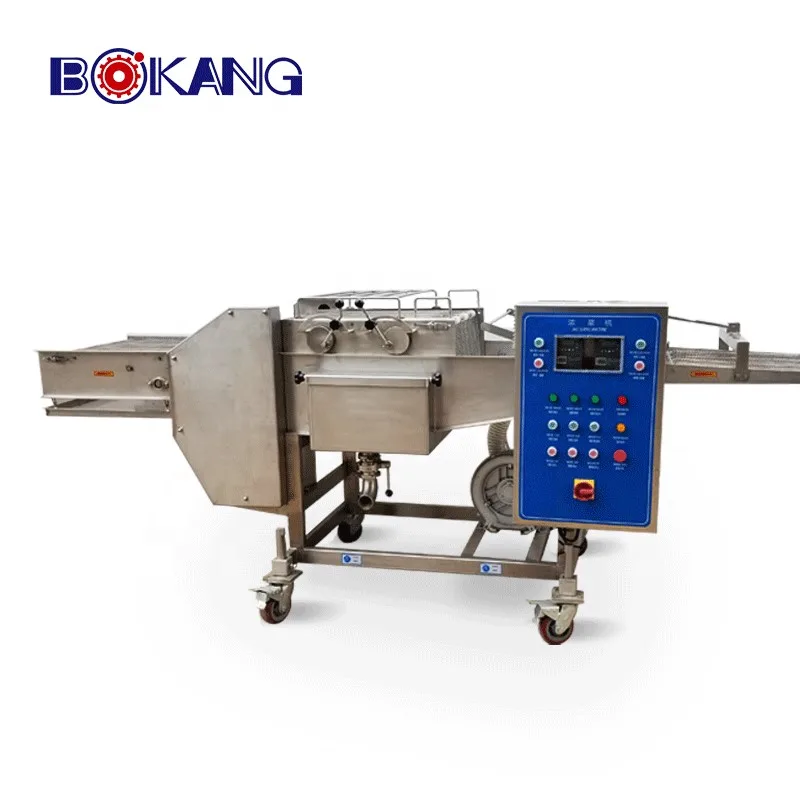
The batter applicator decides how evenly the wet layer goes on, how much batter each piece picks up, and how well the next layer of crumbs sticks. There are two main designs. Choosing between them depends mostly on your batter and your product shape.
Overflow (curtain) applicators
The product travels through a shallow batter bath on the belt while one or more continuous batter curtains fall on it from above. Excess batter is removed by blowers or a wiper under the belt.
- Suits relatively simple shapes such as patties and nuggets
- Needs a batter that can be pumped and recirculated
- Continuous pumping puts shear on the batter, so it is usually not recommended for sensitive leavened (tempura) batters
Bokang machine: LJJ series batter spraying machine — batter curtain plus lower bath, with adjustable pump speed, blower air speed and belt speed, in 300, 400 and 600 mm widths.
Dipping (submerger) applicators
The product runs between a lower conveyor and an upper hold-down belt through a batter bath, so it stays fully submerged. Two settings matter most:
- Batter level must cover the top of the product along the whole bath. If the level drops, the tops are missed and the breading step shows bare spots.
- Belt speed: at high speed the product pushes batter ahead of it, which limits how fast the machine can run.
Bokang machine: NJJ series tempura batter applicator — upper and lower mesh belts with adjustable gap, ice tanks on both sides of the bath to hold batter temperature, and a blower to control pickup. Widths from 200 to 600 mm.
Which one fits your batter and product?
| Situation | Direction to consider |
|---|---|
| Simple shape, non-leavened batter that can be recirculated | Overflow (curtain) |
| Full coverage needed and the product stays stable in the bath | Dipping, with controlled level and belt speed |
| Leavened or tempura batter | Usually a low-shear dipping design |
| Soft, sticky pieces that cling together | Design loading, predusting and transfers together — not just the applicator |
| Concave surfaces or sloped edges | Watch for trapped air and product orientation; test for bare spots |
Tempura batter needs gentle handling
A tempura batter has to keep its leavening power until it reaches the fryer. Long standing times after mixing, strong stirring or pumping, and repeated recirculation all reduce how much the coating puffs.
- Mix dry mix and cold water quickly, gently and completely, then transfer it
- Avoid running tempura batter through the same high-shear recirculation loop as an adhesion batter
- Centrifugal pumps apply strong shear; positive-displacement pumps are generally gentler — but check flow, pressure and particles for your specific batter
- Record the time from mixing to use; compare fresh batter with batter that has been circulating
Batter control: viscosity and temperature
Less water usually means thicker batter and more pickup, but temperature, hydration time, flour protein, damaged starch and gums all change the response. A fixed water ratio does not guarantee a fixed viscosity. Small lines often mix in batches and rely on the operator to monitor and top up; high-volume lines may use a batter station that measures viscosity, adjusts water or dry mix and cools the batter.
Crumbs falling back into the batter also thicken it over time, so check the actual pickup regularly rather than relying only on the mixing recipe.
Getting tempura products into the fryer
Wet tempura coating dropped straight into hot oil can splash and lose batter. Products are better released gently close to the oil surface. Sticky batter also tends to cling to belts with small openings, so open mesh, enough drip time, wiper bars and blow-off are worth checking when you plan the transfer.
What to prepare before choosing
- Your batter type and recipe (or your batter supplier’s product)
- Product shape, size and whether it is fresh or frozen
- Target capacity and the width of the machines before and after
- Whether breading follows, or the product goes straight to the fryer
The fastest way to decide is a trial with your own batter. Our free sample testing covers both NJJ and LJJ machines.
FAQ
Can one batter applicator handle both thick and thin batter?
A dipping machine handles a wide range including thick batters, while curtain machines need pumpable batter. If you run very different batters, test both on your products before deciding.
Why do the tops of my products show bare spots after breading?
On a dipping machine, the batter level may have dropped below the product top. On a curtain machine, the curtain may be incomplete. Check the product right after the applicator, before breading.
How do I reduce batter pickup?
Increase excess removal (blower or wiper), check whether the batter has thickened from crumbs or temperature change, and confirm how pickup is being calculated before adding water.
Technical background: K. Kulp, R. Loewe, K. Lorenz and J. Gelroth (eds.), Batters and Breadings in Food Processing, 2nd edition, AACC International, 2011. Machine data: Bokang Machinery.
Machines mentioned in this guide
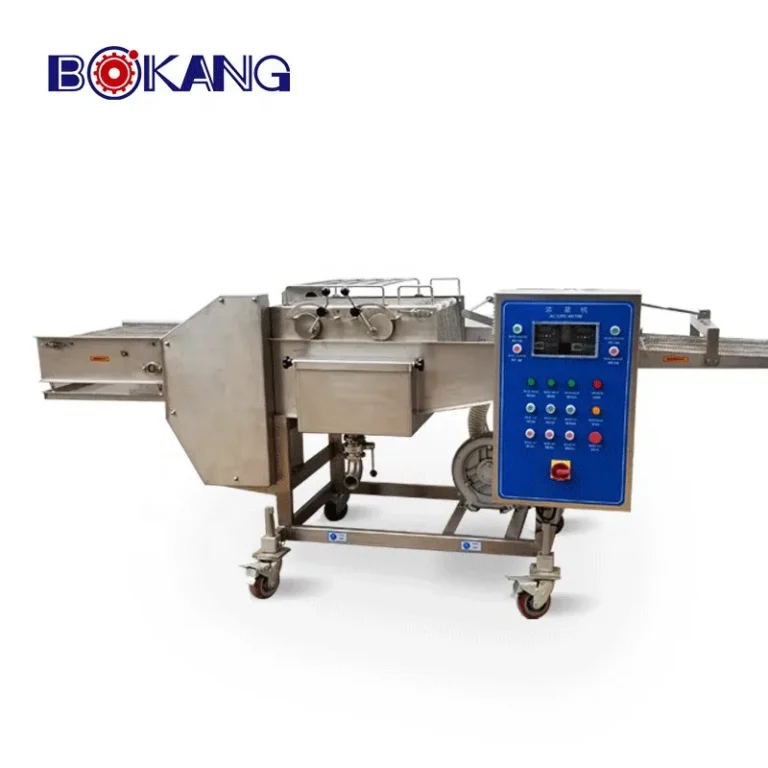 NJJ Series Tempura Batter ApplicatorDipping-type batter machine for thick and tempura batters. Products pass fully submerged between two mesh belts; ice tanks keep the batter cool.View details →
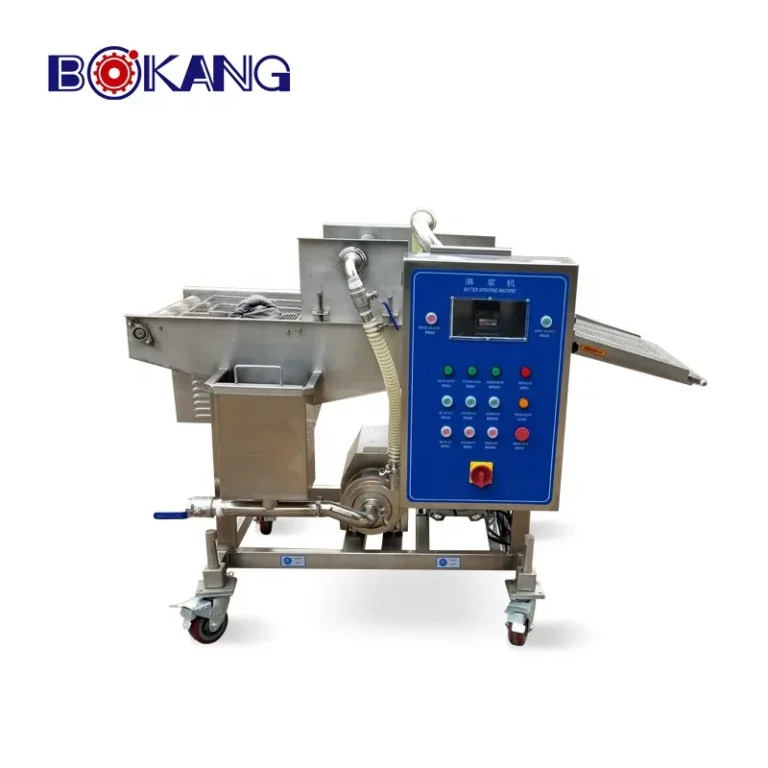 LJJ Series Batter Spraying MachineBatter curtain plus lower bath for an even wet coating on both sides. Adjustable pump, blower and belt speed for thin and medium batters.View details →
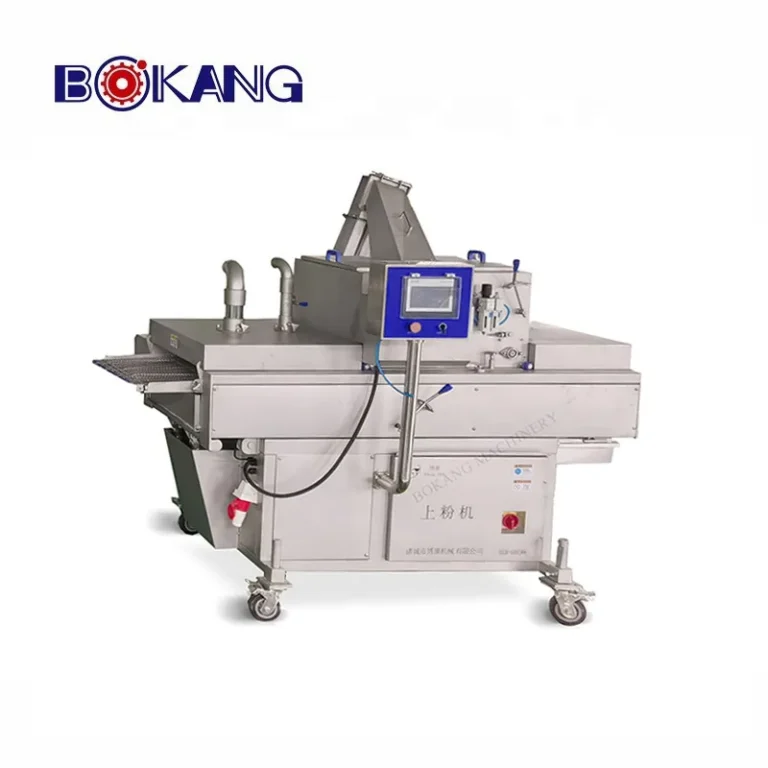 SFJ Series Preduster MachineFlour predusting machine with adjustable top and bottom flour layers, 300–600 mm belt widths. The first step of every batter and breading line.View details →
Test your product on our machines
Send us your raw material, batter and crumbs. We run them on our coating line in our trial lab for free and share the video and results.